


Learn More About Us
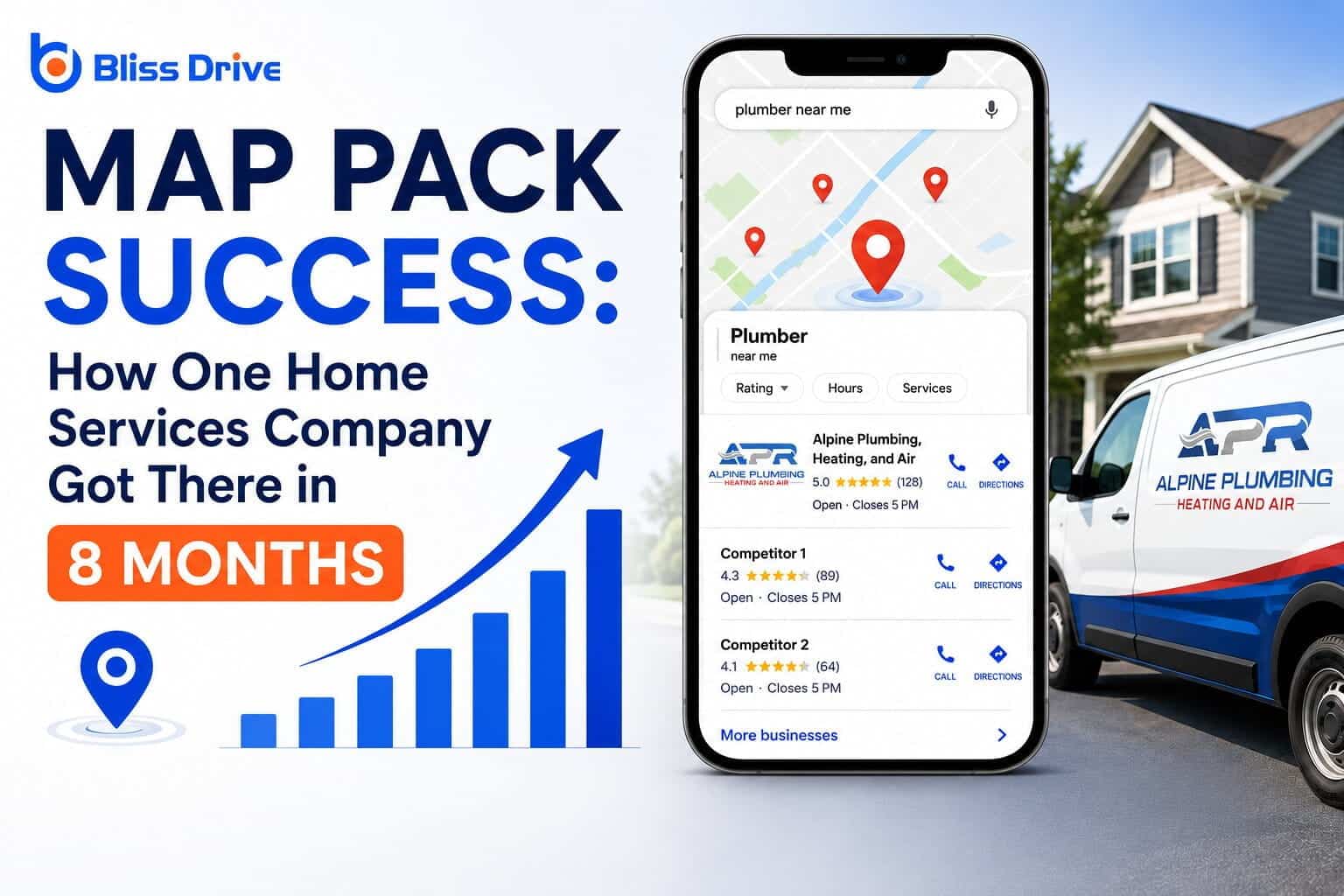
Alpine Plumbing, Heating, and Air went from near-zero Map Pack visibility to 90%+ coverage across three of four core services in eight months. This local SEOOptimization strategies aimed at improving a website’s visibility in local search results. case study matters because 42% of local searchers click a Map Pack result before scrolling further, and Alpine had almost no presence there when the campaignA set of ad groups sharing a budget, targeting options, and other settings. started.
Before the campaign, Alpine ranked in positions 10 to 20 across most of its 169-point service grid for its four core keywords, with Map Pack presence at 0 to 1%. That is not a minor ranking problem. It means a homeowner in San Dimas searching for water softener repair or gas line work almost never saw Alpine on the first page of local results, let alone the map box at the top.
Starting average visibility across the four keywords sat at 38%. Two of them, garbage disposal repair and gas line repair, started even lower, at 34 to 36%. For a plumbing and HVAC company that depends on local, repeat customers, that gap means competitors were winning calls Alpine should have gotten on service quality alone.
The stakes are high because local search moves fast to action. Among consumers who search for a local business on their phone, 88% visit or call within a day. A business invisible in the Map Pack misses that entire window, no matter how good the work is once someone finally calls.
The turnaround came from five coordinated workstreams running at once, not a single fix.
The results followed a foundation-then-breakthrough pattern. GBP and citation signals lifted visibility broadly across the first four months. Map Pack coverage then jumped in the second half of the campaign, as those earlier signals compounded. Water softener repair shows this clearly: visibility climbed from 47% to 77% in four months while Map Pack coverage barely moved, then Map Pack jumped from 1% to 73% in the final three months.
All four tracked keywords finished the campaign at 89% visibility or higher, and three of the four crossed 90% Map Pack coverage. The full grid-level breakdown is in the Alpine Plumbing local SEO case study.
Keyword | Start Visibility | End Visibility | Visibility Gain | Map Pack Coverage |
Water Softener Repair | 47% | 89% | +42 pts | 73% |
Garbage Disposal Repair | 36% | 97% | +61 pts | 93% |
Gas Line Repair | 34% | 99% | +65 pts | 100% |
HVAC Services | 35% | 95% | +58 pts | 93% |
Garbage disposal repair posted the largest single gain, up 61 points, moving from a term where Alpine barely appeared to one where it wins 93% of the local Map Pack. Gas line repair moved fastest: it hit 89% visibility and 89% Map Pack coverage within the first two months, then closed the campaign at 100% Map Pack coverage, the top three spot at every tracked point in the service area.
Winning Map Pack visibility does not stay won on its own. Alpine's results depend on five ongoing workstreams: active GBP management with weekly posts and photo updates, a review pipeline, citation monitoring for NAP drift, monthly ranking-velocity tracking, and expansion into new grid zones once the current ones saturate.
Competitors optimize too, and Google updates its local algorithm regularly. A campaign that stops maintaining these signals after hitting 90% Map Pack coverage typically loses ground within months, not years.
If your home services business is watching competitors show up first on Google Maps while you sit on page two, this case study shows what a coordinated local SEO campaign actually involves: profile work, citations, grid-level tracking, and local content, sustained over months, not a one-time listing update. Bliss Drive's local SEO services team runs this same process for plumbing, HVAC, and other home services clients.
Alpine Plumbing is one of several clients featured in Bliss Drive's comprehensive Local SEO Case Study, covering results across home services, legal, medical, and more.
It depends on the starting position and how competitive the market is. In this case study, gas line repair reached 89% Map Pack coverage within two months because the keyword had less entrenched competition. Water softener repair took the full eight months to cross 70% Map Pack coverage because it started from a stronger competitive baseline.
A visibility grid tracks how a business ranks at many specific points across its service area, rather than from one central address. This case study used a 13-by-13 grid, or 169 points spaced about a mile apart, to show exactly where a business ranks well and where it does not.
For local, service-area businesses, yes, in most cases. Map Pack listings capture roughly 42% of clicks on local search results pages, well ahead of any single organic listing below the map. A business that ranks well organically but is absent from the Map Pack still loses the majority of local search traffic to competitors above it.
Visibility percentage measures how often a business shows up anywhere in local map results across the tracked grid. Map Pack percentage measures the narrower, higher-value case: how often the business ranks in the top three positions that Google displays at the top of the results page.