

Learn More About Us
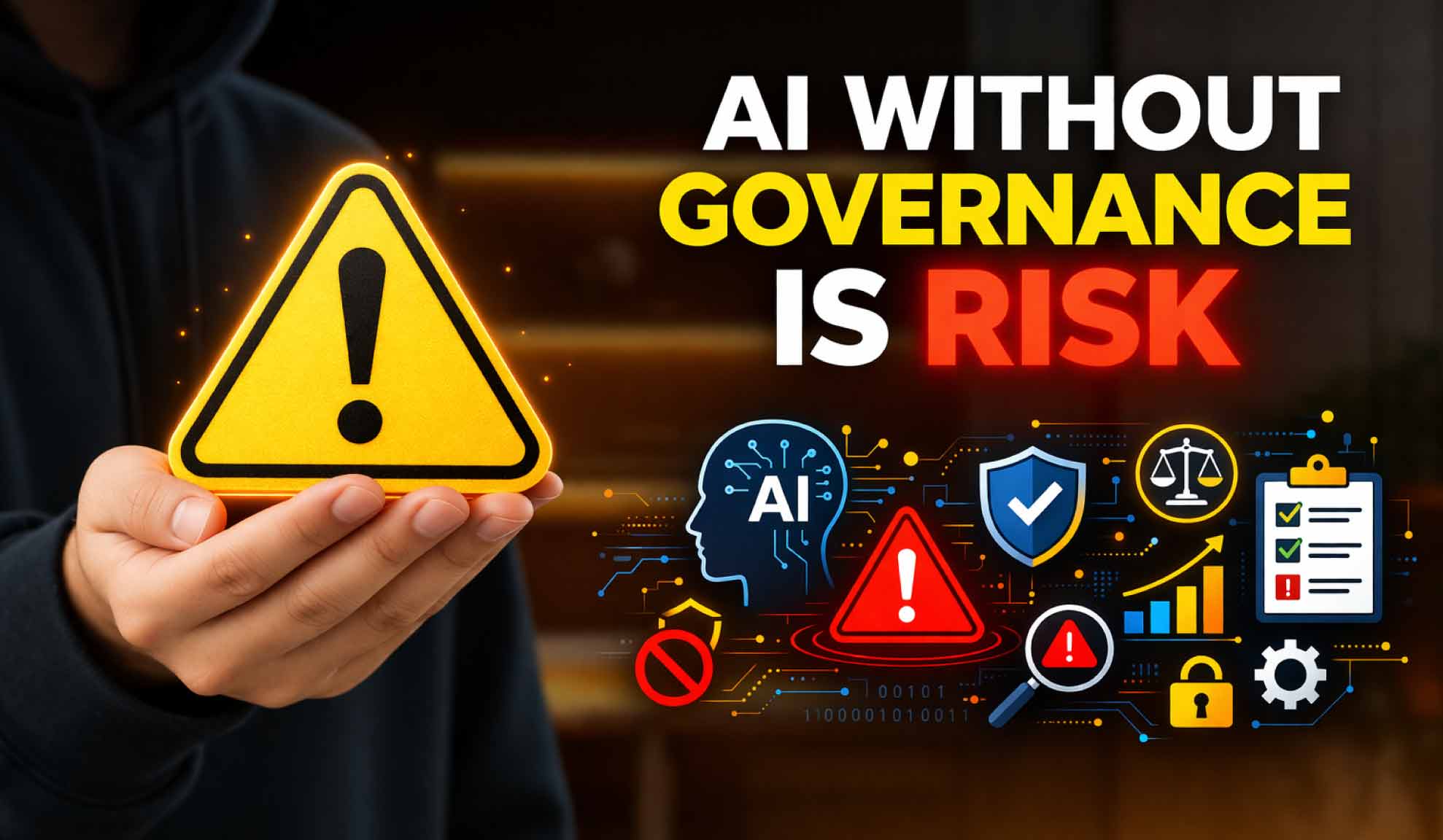
AI governance frameworks turn ethical principles into operating controls that people actually follow. The PwC 2025 Responsible AI Survey reports 60% of executives say responsible AI lifts ROI, and 55% see better customer experience. The companies seeing those gains share one pattern. They treat governance as an operating system, not a policy binder.
Most governance programs die in the gap between policy and operations. They produce a binder. They never produce a control.
Real cases show the cost. A major financial institution had its credit-card algorithm assign lower limits to women with identical financial profiles to men, and the bank could not identify the root cause because it lacked model lineage tracking. Paramount faced a class action over sharing subscriber viewing data without proper consent. A surgical robotics firm later found its analyticsThe systematic computational analysis of data or statistics to gain insights and support decision-ma... tool was generating derived attributes that re-identified anonymized patient records.
These failures share three traits. No inventory of where AI was running. No named owner per model. No monitoring of outputs in production. Policy alone could not catch any of them.
Three frameworks now define what regulators, auditors, and procurement teams expect from an AI program.
Parameter | EU AI Act | NIST AI RMF 1.0 | ISO/IEC 42001:2023 |
|---|---|---|---|
Legal status | Mandatory law, extraterritorial reach | Voluntary, mandated in US public sector | Voluntary certifiable standard |
Primary focus | Fundamental rights, safety, market harmonization | System trustworthiness and risk management | Enterprise management systems |
Risk method | Four fixed risk categories | Flexible, context-dependent mapping | Process-oriented risk assessment |
Enforcement | Fines up to EUR 35M or 7% global turnover | No direct penalties, agency contract enforcement | Third-party certification audits |
The EU AI Act is the only one with direct legal teeth. It applies to any AI system used in the EU, regardless of where the provider is based. NIST AI RMF gives US organizations a flexible blueprint and is referenced in enforcement guidance by the FTC, CFPB, SEC, and EEOC. ISO/IEC 42001 gives multinationals a certifiable standard that satisfies audits across jurisdictions.
A working program covers five areas. Skip one, and the gaps surface under audit or in production.
Starting from scratch, this is the sequence that works:
Steps 1 to 5 deliver the operating model. Steps 6 to 10 deliver the controls. Most programs that stall do steps 1 and 2, then skip the rest.
AI governance is a capability, not a one-time policy project. The companies that make it work assign ownership, inventory their AI systems, monitor production behavior, and treat audits the same way they treat cybersecurity or financial controls.
That same trust discipline should show up in your public-facing content, too. If your business uses AI, customers and search engines need clear signals that your systems, claims, and content can be trusted.
If your AI governance program is already tracking risk, ownership, and accountability internally, the next step is making sure that trust shows up externally, too. Read Bliss Drive’s AI Visibility Audit guide to see what we check, why it matters, and how brands can strengthen their presence across AI search engines.
Data governanceThe management of data availability, usability, integrity, and security in an organization. manages data qualityThe condition of data based on factors such as accuracy, completeness, reliability, and relevance., access, and lifecycle. AI governance covers the same plus the dynamic behavior of models, including drift, bias, emergent capabilities, and the decisions models make. A data governance program does not catch a model recommending a biased hiring outcome. An AI governance program does.
Yes, if the AI system is used by anyone in the EU. Jurisdiction is based on where the system is deployed, not where the company is based. The Act caps SME fines at the lower of the fixed amount and the percentage of turnover, but the obligations still apply. High-risk obligations apply from August 2, 2026.
For US-based companies, start with NIST AI RMF. It is voluntary, but federal agencies, including the FTC, CFPB, FDA, SEC, and EEOC, reference NIST principles in enforcement. For multinationals, layer ISO/IEC 42001 on top of NIST to get a certifiable standard. EU exposure means EU AI Act compliance is mandatory regardless.
Static policy checks do not work for systems that plan and act. Governance for AI agents requires runtime controls: policy enforcement at the action layer, rate limits on transactions, and mandatory human authorization for high-consequence steps like financial transfers or data deletions.