
Learn More About Us
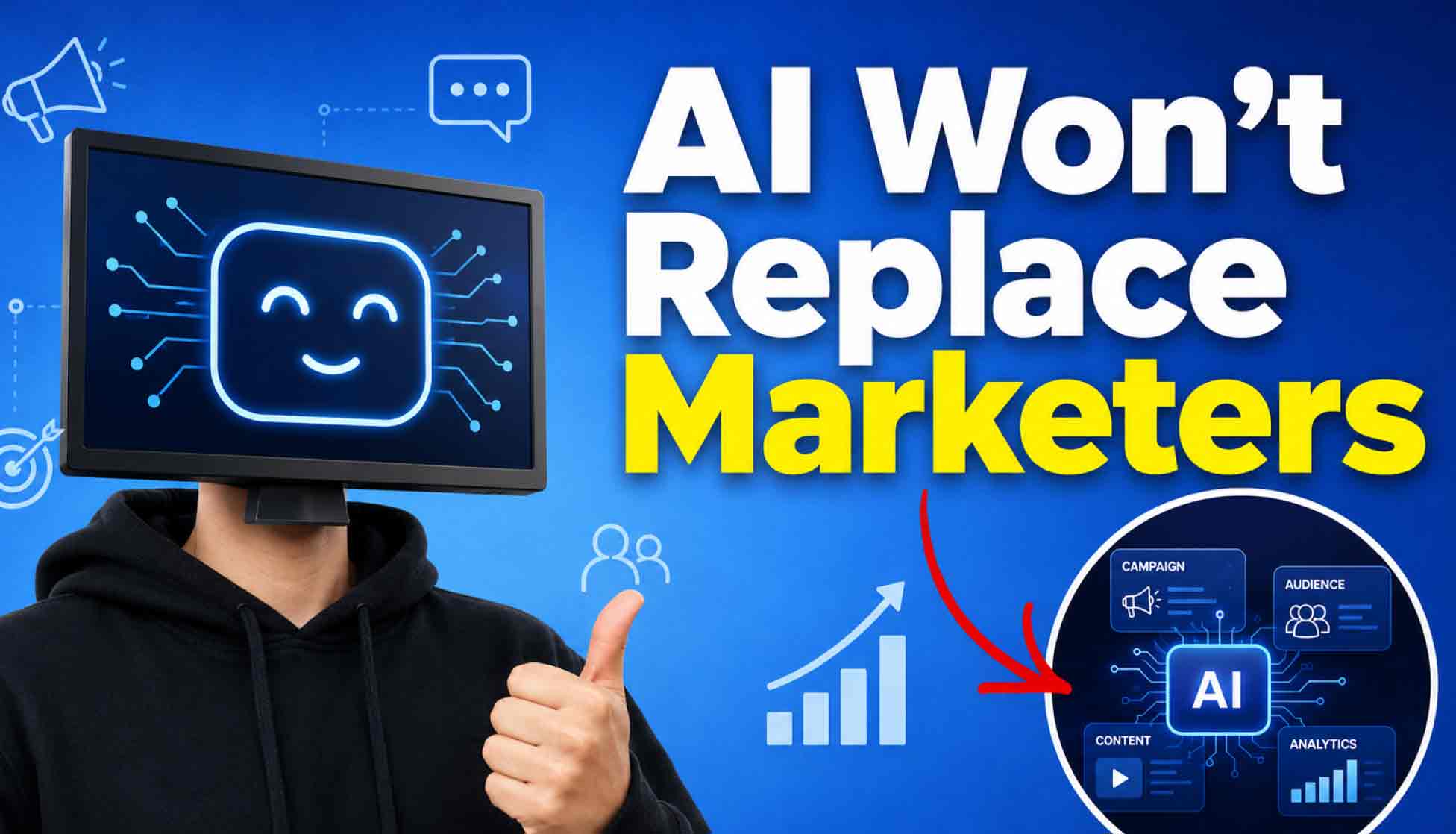
AI is not going to take your marketing job. But it will change what that job looks like. According to HubSpot's 2026 State of Marketing Report, 80% of marketers already use AI for content creation, and 75% use it for media production. That adoption rate tells you AI is not a future concern. It is already in the room, and the marketers who adapt are pulling ahead.
The fear of replacement is understandable, but the data does not support it. A January 2025 study from Ascend2 found that 56% of marketing professionals have AI in active production use, with 17% running it extensively across multiple channels. Despite that scale of adoption, concerns about AI-related job losses remain.
The tension shows up in how marketers feel about it. The Conference Board found that 82% of marketers expect AI to improve their productivity. Yet 40% still worry it could reduce jobs. Both things can be true at the same time: AI makes marketers more productive, which often leads to more work, not less.
What makes this moment different is that AI is handling the low-leverage work. Drafting first-pass copy. Resizing assets for different platforms. Cleaning datasets. Running attribution models across multi-touch journeys. Marketers who understand that are reinvesting that recovered time into strategy, brand voiceThe consistent tone and style of communication used by a brand across all channels., and creative direction. That is where the floor of marketers rises, not where the ceiling drops.
Consumer trust is the piece that AI cannot replicate. Studies show the percentage of consumers comfortable with brands using AI has been declining each year. The more AI-generated content floods the internet, the more skeptical buyers become about whether anyone is actually behind the brand.
That skepticism has a practical consequence. Nine out of ten people still prefer a human customer service representative over a chatbot for complex issues. That preference is not going away. If anything, it increases as AI gets more common. The human signal becomes a differentiator, not a given.
Marketers provide what AI cannot: empathy, cultural judgment, and the ability to read what a customer actually needs versus what they typed. AI produces content at scale. Marketers decide which content is worth producing, what it signals about the brand, and whether it resonates with real people in a specific moment.
The change is not about doing less. It is about doing different things. Here is how specific functions are evolving:
Traditional Marketing Role | AI-Augmented Marketing Role |
Writing first drafts from scratch | Prompt engineering + editing AI-generated drafts |
Manual keyword researchThe process of finding and analyzing search terms that people enter into search engines. over several hours | AI keyword clustering reviewed and refined by the strategist |
Building attribution models in spreadsheets | Interpreting AI-generated attribution insights for budget decisions |
Resizing creative assetsMarketing materials provided by merchants for affiliates to use in their promotional efforts, such a... for each platform | AI auto-scales assets; marketer directs the visual concept |
Monitoring ad bids hourly | Reviewing AI-optimized bids; strategist sets audience and creative direction |
IBM needed to localize campaigns across multiple global markets. Instead of scaling headcount, it used Adobe Firefly to generate over 200 original images with more than 1,000 variations, all within IBM's brand guidelinesA set of rules and standards that define the visual and verbal elements of a brand..
The result: 26 times higher engagement compared to IBM's benchmarks for similar non-AI campaigns, with 20% of the engaged audience being C-level decision-makers. IBM's design team was not cut. Their output was multiplied.
Starbucks built a predictive AI system called Deep Brew that analyzes past orders, time of day, weather conditions, and location to recommend orders inside the mobile app. The system increased order frequency and per-customer spend. The marketers behind it are not out of a job. They are managing an AI-powered personalization engine that would be difficult to operate manually at the same scale.
Verizon deployed AI to give customer service agents live context during calls, including customer history and suggested responses. The outcome: in-store visit times dropped by approximately seven minutes per customer, and Verizon said it expected the technology to help prevent about 100,000 customers from leaving. Human agents did not lose their jobs. They became more effective at them.
The skills gap is real and creates an opening. Many employers report difficulty finding candidates with the AI skills needed for emerging roles. That is not a threat to marketers who are willing to upskill. That is a hiring advantage.
AI will change what marketing work looks like. It will not change the fact that marketing is fundamentally about building trust with people. The marketers who treat AI as a tool rather than a threat are already producing more, spending less time on repetitive work, and positioning themselves as more valuable to their teams and clients.
For businesses looking to build an AI-first marketing strategy, Bliss Drive's AI visibility services cover how to show up in ChatGPT, Perplexity, and Google AI Overviews, where buyers are doing their research right now.
AI is more likely to automate repetitive marketing tasks than eliminate entire roles. Marketers who combine AI fluency with strategy, creativity, and customer insight should remain valuable.
AI can assist with first drafts, keyword clustering, asset resizing, data analysisThe process of inspecting, cleaning, transforming, and modeling data to discover useful information...., personalizationTailoring content and offers to individual users based on their behavior, preferences, or demographi..., and campaign optimization. Human review is still necessary for accuracy, brand voice, and judgment.
Marketers should develop prompt-writing skills, analytical thinking, AI quality control, strategic planning, and a strong understanding of customer behavior.
AI can generate ideas and analyze data, but it cannot independently understand business priorities, competitive context, or cultural nuance well enough to replace experienced strategic oversight.
Businesses should use AI to support production and analysis while retaining human responsibility for brand voice, final approval, customer communication, and ethical decisions.