Learn More About Us
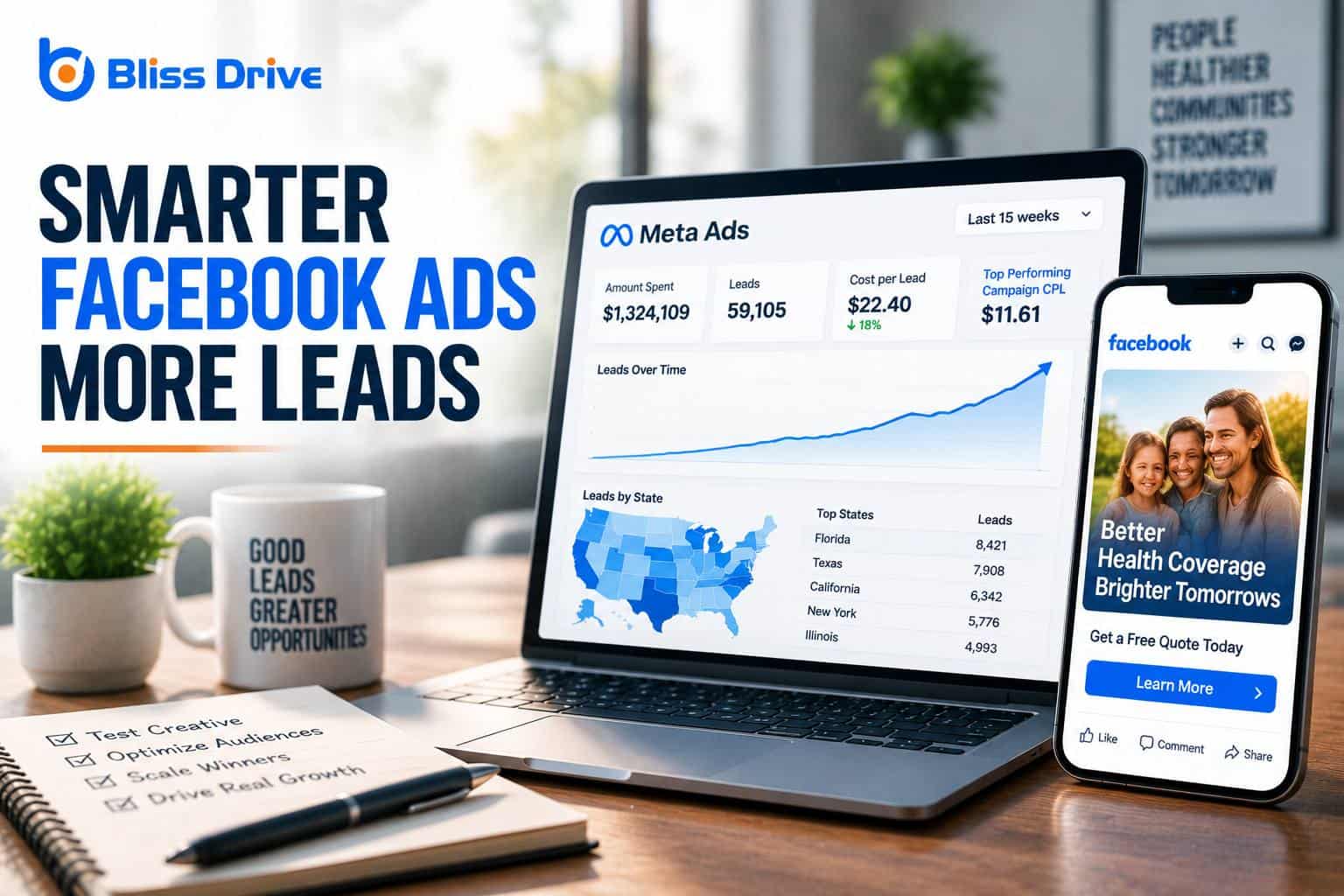
FacebookA social networking site where users can post comments, share photographs, and links to news or othe... ads for health insurance leads can work at real scale. One Meta account produced 59,105 leads at a $22.40 blended cost per leadA potential customer referred by an affiliate who has shown interest in the product or service but h... over 15 weeks on $1,324,109 in spend. The all-industry average for Facebook lead campaigns is $27.39, according to WordStream’s 2026 benchmark study. Structure, not luck, created that gap.
Health insurance advertising on Meta is expensive because the targeting shortcuts are gone and the auction stayed crowded. Meta removed detailed targeting options related to health on January 19, 2022, including selections such as “Chemotherapy” and “Lung cancer awareness.” Advertisers lost the levers and kept the rivals.
Demand explains the crowding. CMS reported on January 28, 2026, that 23.0 million people signed up for 2026 individual market coverage, 3.4 million of them new to the Marketplaces. Carriers, brokers, and lead buyers chase that same window on the same platform.
The auction reflects it. Finance and insurance post the highest cost per click and the lowest click-through rate of any industry in WordStream’s 2026 Facebook traffic data, at $0.86 and 1.46%. This account paid a $25.45 CPM.
At high volume, the math turns unforgiving fast. An account buying 4,000 leads a week loses $12,000 a week to a $3 slip in cost per lead. Cost control belongs in the account structure, not in a post-invoice audit.
Two decisions carried the account: pay according to what a state’s leads are worth, and scale only what a bid ceiling has already proven. Together they turned cost per lead into a number the account defends rather than one it hopes for.
Managing campaigns at this scale requires ongoing testing, bid adjustments, creative analysis, and performance tracking. A structured PPC management approach helps keep campaigns aligned with cost targets while identifying opportunities to scale.
Health insurance commissions vary by state, so a $15 lead in one state can be worth less than a $30 lead in another. Audiences were sorted into six performance tiers, Tier 1 through Tier 6. Budget followed the tiers returning the most value per lead, not the cheapest lead on paper. Per-state cost-cap breakouts ran in California, Colorado, Ohio, Texas, and Virginia. Tier 1 and Tier 2 campaigns each carried six figures in spend at costs per lead in the low-to-mid $20s.
Broad targeting handled reach. Lookalikes built from a proprietary health-policy converter audience and 30-day engagers sharpened it. Cost-cap and target-CPL bidding then set the price ceiling. A cost cap tells Meta the maximum average you will pay for a result, so delivery has to find leads under that number instead of spending to the daily budget. The full health insurance PPC case study highlights the same principle: CPL was treated as a dial to protect, not a number to hope for.
Creative did the rest. UGC-style videos, short-form offerThe specific product or service being promoted by affiliates. ads, B-roll variants, and continuous copy iteration kept fresh hooks moving into the top audiences before fatigue set in.
The story lives in the spread between test costs and scaled costs. Blended cost per lead is total spend divided by total leads across every campaign, failed tests included, which is why it sits well above the winners.
Stage | Cost per lead | What it represents |
|---|---|---|
Earliest tests | Low $40s | Unproven audiences and creative |
Blended, 15 weeks | $22.40 | 59,105 leads on $1,324,109 in spend |
Winning scaled campaigns | $14.08 to $14.46 | Proven structures at full volume |
Best single campaign | $11.61 | Top performer in the window |
Facebook leads average, all industries | $27.39 | WordStream 2026 benchmark |
Delivery reached 22.7 million people and served 52 million impressions at a 2.32% link click-through rate. Every dollar moved out of a $40 lead and into a $12 lead is margin on the same budget. That is the entire financial argument for disciplined testing.
Cutting losers fast matters just as much. Roughly 60 structures never earned scale, and that graveyard is what funded the winners.
A successful paid campaign depends on more than ad performance. Lead quality, funnel structure, and conversion trackingThe process of monitoring and measuring actions taken by users after clicking on an ad. all influence whether acquisition costs translate into revenue. A strong lead generation campaign framework helps connect media spend with the business outcomes that matter.
Facebook ads for health insurance leads are not won through targeting shortcuts. This campaign showed that scalable results come from disciplined testing, value-based audience segmentationDividing a social media audience into smaller groups based on specific criteria for targeted marketi..., creative iteration, and cost controls that protect profitability. The same approach can help other high-volume lead generationThe process of attracting and converting prospects into potential customers. campaigns improve efficiency while scaling.
For businesses looking to build a more predictable paid acquisition system, reviewing campaign structure, bidding strategy, and conversionThe completion of a desired action by a referred user, such as making a purchase or filling out a fo... data is the right place to start. Bliss Drive helps businesses build and manage data-driven PPC campaigns focused on measurable growth.
Health insurance is a hard category, but the playbook is repeatable: test widely, cut losers fast, tier audiences by value, and let a bid ceiling protect the number that decides profitability. Bliss Drive builds and runs this system through its pay-per-click management team.
WordStream’s 2026 data puts the average Facebook lead campaign at $27.39 per lead across all industries. Insurance sits among the most competitive categories, so a blended $22.40 across 59,105 leads is a strong result. Judge your own number against policy commissionThe fee paid to an affiliate for generating a sale, lead, or other desired action. value, not against a national average.
No. Meta removed detailed targeting options related to health topics on January 19, 2022, and campaigns using them stopped delivering after March 17, 2022. Health insurance advertisers now rely on broad targeting, lookalike audiencesAudiences that resemble an advertiser’s existing customers, used for targeting in various ad platfor... built from their own converter lists, and creative testing to reach qualified prospects.
This account launched more than 100 structures and concentrated spend into roughly 40 that proved they could hold cost per lead. The ratio matters more than the raw count. Expect most tests to fail, budget for that, and move spend quickly once a structure holds its cost target at volume.
It can, and that is the trade-off. A cost cap set too low starves delivery and the campaign underspends. Set at a realistic ceiling above your proven cost per lead, it lets Meta scale aggressively while protecting the price. Winning campaigns in this account held $14.08 to $14.46 per lead at six-figure spend levels.