
Learn More About Us
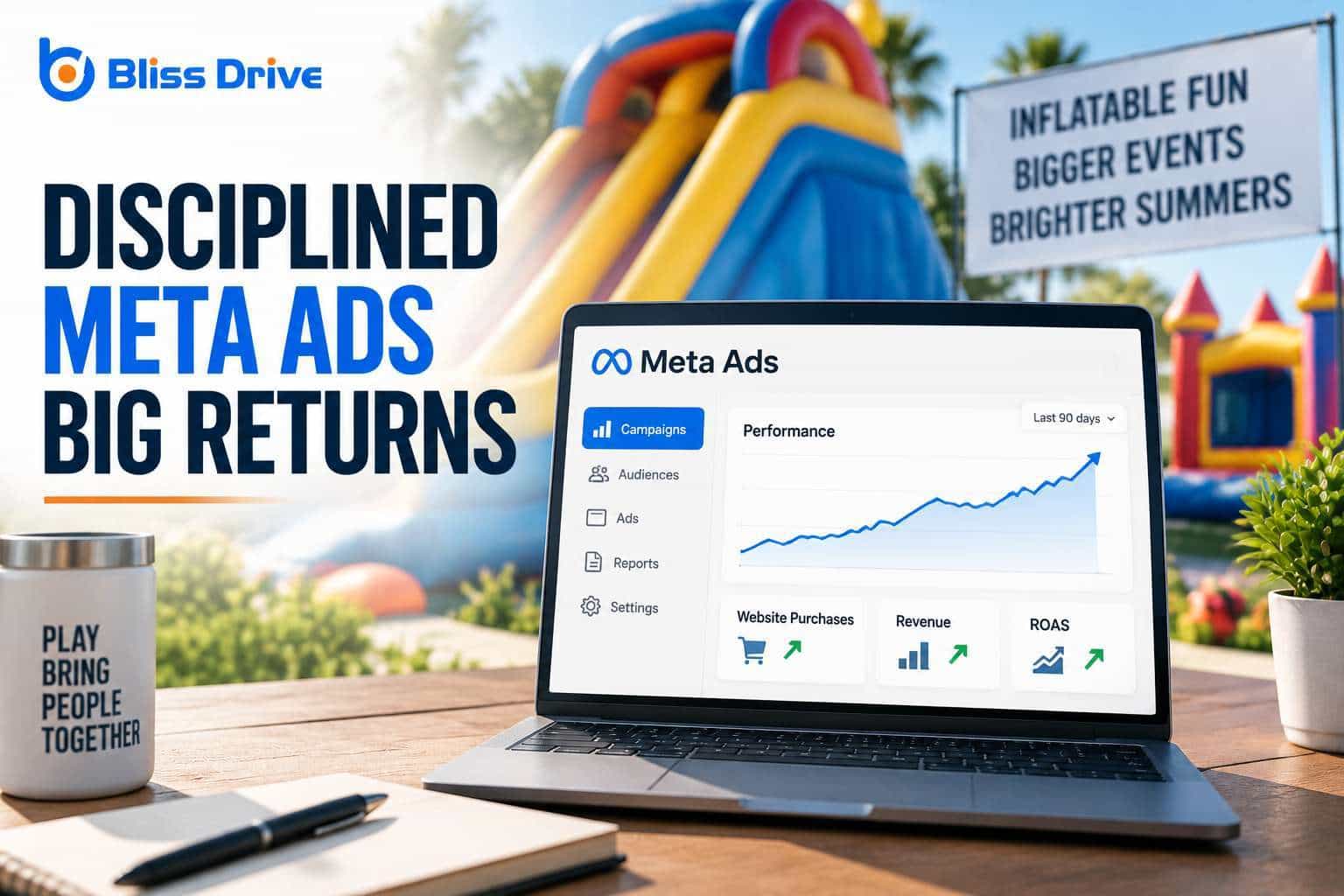
High-ticket Meta ads work when budget concentrates on proven products instead of spreading evenly across a catalog. Between April 1 and July 14, 2026, JumpOrange spent roughly $48,000 on Meta and tracked about $995,000 in online sales. That is a blended 20.7x return on ad spendThe total amount of money spent on advertising campaigns. across 338 purchases at a $2,940 average order value.
A $3,000 product rarely sells on first impressionWhen an ad is displayed on a user’s screen., so high-ticket Meta ads have to fund a longer decision window instead of a single click-to-cart path. Most Meta advice assumes a $40 impulse buy. The math changes completely above $1,000.
JumpOrange sells commercial-grade inflatables: water slides, bounce houses, obstacle courses and party units. Units start above $3,000. Buyers are rental operators, event companies, schools and churches who compare specs, check delivery timelines, and often wait for a promotion before committing.
That creates two problems. Small test budgets produce very few conversions, and Meta's delivery system needs a steady flow of conversionThe completion of a desired action by a referred user, such as making a purchase or filling out a fo... events before an ad set leaves its learning phase. A $3,000 product generates those events slowly.
The second problem is abandonment. Baymard Institute puts the documented average ecommerce cart abandonment rate at 70.22%, calculated across 50 separate studies. At a $2,940 average order value, every abandoned cart is worth chasing.
Product-level testing runs one small campaign per product, then moves budget only after a unit proves it can sell. The structure JumpOrange used followed five steps:
More than 80 campaigns ran across the window, and returns varied sharply by unit. An 18-foot slide returned 50x. A DJ booth unit and a 25-foot oasis unit both cleared 40x. No planning session picks those three products in advance. Spending $30 a day for a week does. This is the same discipline that a structured paid campaign process applies to search, moved onto paid social.
Retargeting produced the highest returns because high-ticket buyers research before they purchase, so the second and third impressions close what the first one started. One June water-slide retargeting campaign turned $5,400 in spend into $179,000 in revenue, roughly a 33x return. The campaign analysis showed that retargeting was the engine behind the strongest returns.
July paired a prospecting campaign with a retargeting campaign behind a single 50% off promotion. Together they produced more than $170,000. The pairing is the point. Retargeting has nothing to work with once prospecting stops feeding it, which is the same reason remarketing reconnects buyers who left without purchasing rather than replacing acquisition.
Promotions were also timed to demand. Spring, Memorial Day, and the June and July sales calendar all line up with when inflatable buyers are actually shopping.
The traffic metrics were ordinary. The economics were not.
Metric | JumpOrange, Apr 1 to Jul 14, 2026 | Shopping and gifts average |
|---|---|---|
Click-through rate | 1.70% | 1.88% |
Cost per click | $0.76 | $0.59 |
Impressions | 3.7 million | Not published |
Average order value | $2,940 | Not published |
Cost per sale | $142 | Not published |
Blended ROAS | 20.7x | Not published |
Both traffic numbers trailed the category average reported in WordStream's 2026 Facebook ads benchmarks. The return came from what happened after the click. Blended ROAS, meaning total tracked revenue divided by total ad spend across every campaign rather than a single ad set, reached 20.7x.
One honest caveat: this was a 90-day window aligned to peak season. Spring and summer demand did part of the work, and the same structure running in November would not produce the same numbers.
You don't win high-ticket Meta ads by spending more upfront. They work by identifying which products, offers, and audiences generate real purchases, then scaling what already proves profitable. The JumpOrange campaign shows how focused testing, seasonal timing, and consistent retargeting can turn paid social into a measurable revenue channel for products with longer buying cycles.
For ecommerce brands evaluating Meta ads for high-value products, Bliss Drive’s pay-per-click team helps build testing frameworks, analyze margins, and structure campaigns before scaling ad spend.
There is no universal number, because break-even depends on gross margin. A product at 30% margin needs roughly 3.3x just to cover ad spend, while a 60% margin product breaks even near 1.7x. The JumpOrange campaign reached 20.7x blended, well clear of break-even at any realistic margin. Calculate your own floor before judging any campaign result.
$15 to $50 per day per product is enough to learn whether a unit converts, which is the range used across the JumpOrange tests. Run each test long enough to collect purchase data rather than judging on clicks alone. For a product above $1,000, that usually means a week or more before making a keep-or-cut decision.
Enough that prospecting always has somewhere to hand buyers off. High-ticket shoppers rarely purchase on first contact, and roughly 70% of ecommerce carts are abandoned, so retargeting is where most of that revenue gets recovered. In the JumpOrange campaign, the single highest-return campaign of the window was a retargeting campaign at 33x.
Usually not. JumpOrange concentrated spend between April and July, which is when inflatable demand peaks, and tied promotions to the spring, Memorial Day, and midsummer sales calendar. Spreading the same $48,000 evenly across twelve months would have pushed budget into months with far weaker demand and thinner returns.